Cold Weather Masonry: Where the Real Limits Are
Masonry in Middle Tennessee has a real winter slowdown, and any contractor who says otherwise is skipping something. Here is where the limits are and what still gets built.
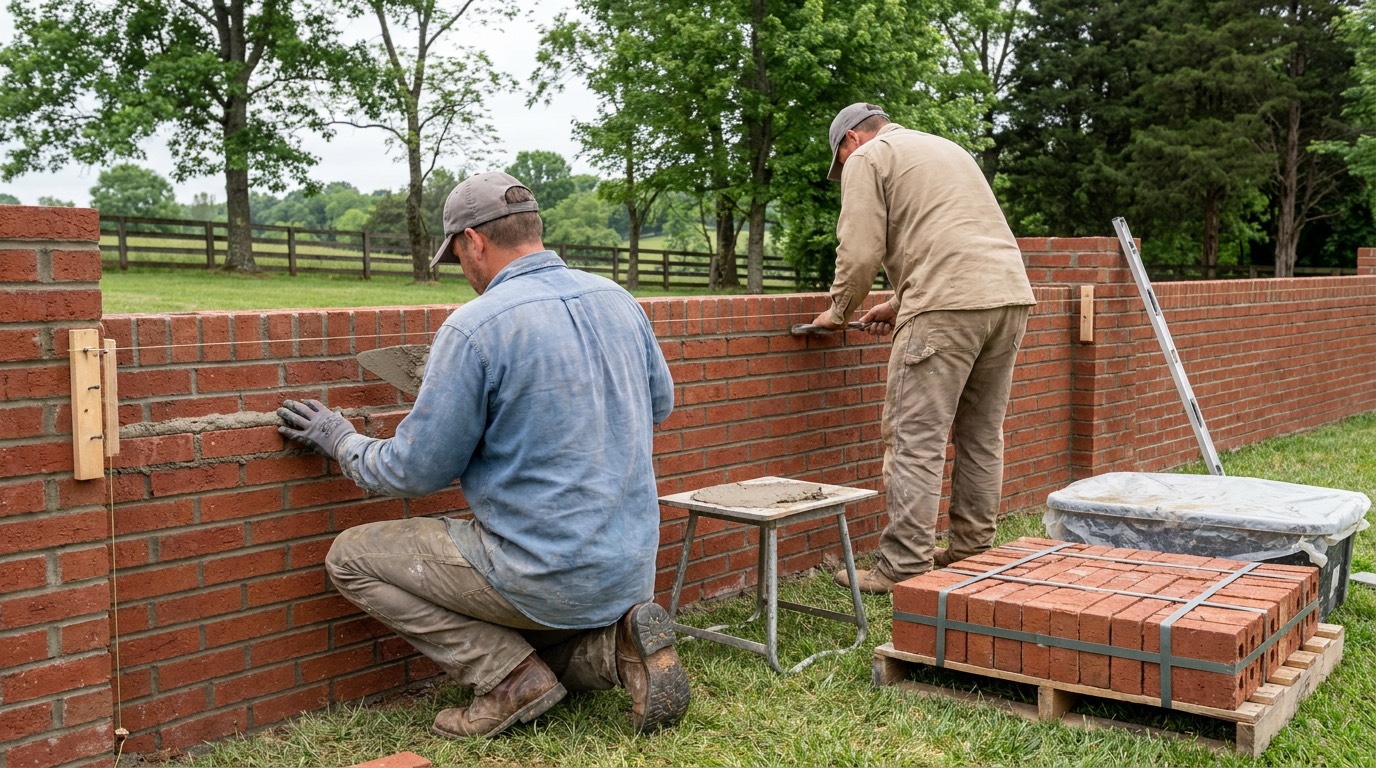
Mortar is a chemical reaction, and cold slows it down
Mortar does not dry. It cures, through a reaction between cement and water called hydration, and that reaction needs both heat and liquid water to run. Drop the temperature and the reaction slows. Drop it far enough and the water in the mix freezes, expands, and pushes the paste apart from the inside before it has developed any strength.
That is the whole problem in one sentence. A joint that froze in its first day never bonds properly to the brick, and no amount of warm weather afterward fixes it. The joint will look finished. It will not perform.
What the forty degree rule actually means
The working guideline in the trade is that ordinary mortar placement stops around forty degrees Fahrenheit without cold weather measures. That number gets quoted loosely, so it is worth being precise about what it refers to.
It is not just the air at the moment of placement. It is the temperature of the materials, the temperature of the wall the mortar is going onto, and the temperature over the next day or two while early strength develops. A wall built at forty five degrees in the afternoon and left uncovered through a twenty eight degree night is at risk, and Murfreesboro nights swing hard below the daytime high from December through February.
It is also the direction of travel. Forty and rising at nine in the morning is a workable day. Forty and falling at three in the afternoon is not the same call. The Masonry Society publishes the industry masonry specification, and cold weather construction requirements in it tighten in stages as the temperature drops rather than switching off at one number. Your contractor should be watching the National Weather Service forecast for the following forty eight hours, not just the thermometer on the truck.
Want a price for your own wall?
Four quick questions and we come back with a written quote. Or call (772) 251-6654 if that is faster.
Request a quote
Four questions, about a minute. We'll call you back.
What real cold weather protection looks like
Winter masonry is not impossible, it is more expensive. Every measure below costs labor, fuel, or material, which is why a winter quote for the same scope can run higher than a spring quote. That difference is legitimate and worth paying when the schedule genuinely requires the work.
What matters is that protection is a system. Heating the mix and then leaving the wall bare overnight buys nothing.
- Heated mixing water, and heated sand once it gets cold enough
- Materials stored off frozen ground and kept covered and dry
- Snow, ice, and frost removed from the wall and the units before anything is laid
- Insulated blankets over completed work, held down against wind
- Full enclosures with supplemental heat on larger or longer jobs
- Windbreaks, because wind pulls heat out of a fresh wall faster than still cold air
- Shorter working days, so fresh work has daylight hours to gain strength before nightfall
Things that are not cold weather protection
Antifreeze admixtures marketed for masonry do not stop mortar from freezing at any useful dosage. They accelerate the set, which is a different thing, and they are frequently sold as if they were the same.
Calcium chloride is the one to refuse outright in mortar. It speeds the set, and it also corrodes the metal in the wall, which on brick veneer means the ties holding the whole face back to the house and any reinforcement in the joints. Trading twenty years of tie life for one cold week is a bad deal.
Adding extra water to a stiff cold mix, working over frozen ground, and laying on a wall with frost on it are all the same mistake in different forms. If a crew is doing any of them, temperature is not the problem on that job.
How cold weather failures actually show up
This is the part homeowners rarely hear, and it is why the temptation to push through a cold week is worth resisting. Mortar damaged by freezing usually looks completely normal when the crew leaves.
The evidence turns up months later. Joints that crumble under a fingernail by the following autumn. Bond that never developed, so units sound hollow or move under hand pressure. Persistent white staining running down the face from lime washed out of an undercured joint. Color that came out blotchy across a wall because sections cured at different rates.
By then the season is long over, the connection to that cold week is not obvious, and the repair is a rebuild rather than a touch up.
Winter work that has nothing to do with mortar
The season is a slowdown, not a stop. Plenty of useful work does not depend on a curing joint, and a mild stretch in a Middle Tennessee January is often perfectly workable for it.
This is also the right time to get the paperwork out of the way, because the queue for spring starts filling in February.
- Inspection and assessment, which is often easier with bare trees and no foliage
- Chimney evaluation, camera work, and cap or damper replacement
- Interior firebox and hearth work, done inside a heated house
- Demolition and removal of failed masonry ahead of a spring rebuild
- Dry laid segmental retaining wall systems, where the ground is not frozen
- Drainage, grading, and downspout corrections around a wet foundation
- Estimating, engineering, HOA architectural submissions, and permit applications
Scheduling honestly around the season
The reliable exterior mortar window in Rutherford County runs from roughly March through November, with the shoulder weeks either side depending entirely on the year. Some Decembers give a run of fifty degree days. Some Februaries do not.
If you find a problem in October, book it in October. Waiting until January means either paying for protection or waiting for spring, and by March the schedule is already competitive across Murfreesboro, Smyrna, and the whole Nashville metro. If the wall is open to weather and cannot wait, temporary protection is a legitimate stopgap. Covering an exposed wall properly costs very little and buys months.
One last filter for choosing a contractor. Ask what happens if the forecast turns during your job. A mason who explains the protection plan, the added cost, and the conditions under which they would reschedule is telling you they have thought about it. A mason who says cold is never an issue is telling you something too.
Related questions
It is fifty degrees and sunny in January. Can you lay brick that day?
Possibly, and what settles it is the overnight low two nights out, not the reading at lunchtime. Fifty degree afternoons are ordinary in a Murfreesboro January and they sit between nights in the twenties more often than not. Mortar is still curing while that happens. If the forecast holds above freezing through the following forty eight hours, a mild winter day is workable. If it drops after dark, the work gets covered and protected or it does not go up.
Does winter masonry cost more?
Usually yes, when protection is required. Heated materials, blankets, enclosures, fuel and short daylight all add cost, so the same scope can price higher in January than in May. Travel counts for more in winter than it does in June, because the crew cannot start until the materials and the wall have come up in temperature, and an hour of that spent driving out to a job near Manchester comes off a day that is already ending at five. Ask for the protection measures to be itemized so you can see what you are paying for.
My chimney is leaking now. Do I have to wait until spring?
Not necessarily. Stopping the water often means flashing, a cover, or a temporary wrap, none of which depend on curing mortar. Get the water stopped in the cold and schedule the masonry rebuild for the spring window. That sequence is normal and it protects the wall in the meantime.
What about repointing in winter?
Repointing is mortar work, so the same limits apply, with one extra wrinkle. Repointing needs the joint damp for a proper bond, which means introducing water into a wall right before a freeze. That combination is worse than new construction, so it is one of the first things we push to spring.
The crew worked through a cold snap on my house. How do I check it?
Wait for warm weather, then run a fingernail and a key along the new joints and compare them to older sound joints elsewhere. Sandy, crumbling, or soft joints, hollow sounding units, or white staining running down the new work are the signals. Photograph anything you find and raise it in writing while the workmanship warranty is live.
Is concrete block work subject to the same limits?
Yes, because it is the same mortar, and often grout as well, and grout carries even more water into the wall. Block foundations and block retaining walls follow the same cold weather rules. Dry laid segmental walls are the exception, and those are limited by frozen ground instead, which in Middle Tennessee is a much softer limit than the mortar one. The ground here rarely freezes deep or stays frozen long. On most winter jobs it is the mortar that stops work, not the excavator.
References
Standards bodies and agencies referenced above. We are not affiliated with them.
More guides
All guides →Cracked Brick Veneer or a Structural Crack? How to Tell
Not every crack in a brick wall means the house is moving. Here is how to read one, which patterns are cosmetic, and the point where guessing should stop.
ReadCrumbling Mortar: How to Tell When Brick Needs Repointing
Mortar is designed to be the part that gives up first. The useful question is not whether yours is deteriorating, but how deep it has gone and whether it is time to act.
ReadWhite Residue on Brick: Reading Efflorescence Before You Scrub It
Efflorescence is not a stain sitting on your brick. It came out of the wall, dissolved in water, and the pattern it leaves is a map of where that water is getting in.
ReadFoundation Repair Cost in Middle Tennessee: How the Number Gets Built
Block repair, carbon fiber, piers and underpinning all get sold as foundation repair, and they are not the same work. What moves the price in Rutherford County, and where a mason stops and an engineer starts.
ReadFreeze-Thaw: Why Middle Tennessee Brick Breaks Down
It is not the cold that breaks brick. It is water in the brick, crossing freezing over and over, which is exactly what a Middle Tennessee winter delivers.
ReadStraight answer on your wall.
Call, or send the form and we will get you a written price.