The Real Masonry Season in Middle Tennessee
Unlike trades in the Sunbelt, masonry in Rutherford County has a genuine season. Here is how each part of the year behaves, and why winter is a slowdown rather than a shutdown.
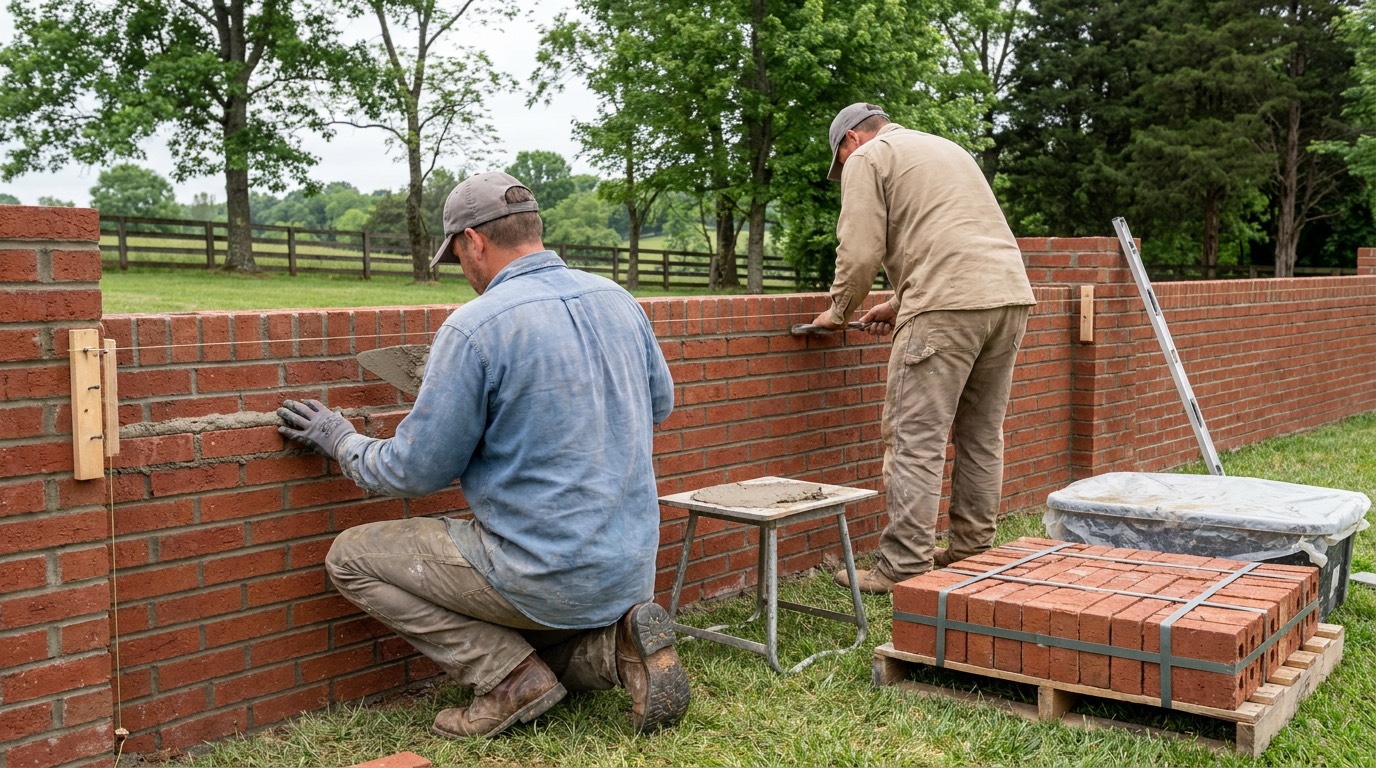
Why there is a season at all
Mortar is not glue. It is cement and lime and sand that gain strength through a chemical reaction with water, and that reaction slows as temperature drops. Below roughly 40 degrees it slows enough to matter. If the water in fresh mortar freezes before the mix has set, the bond is damaged permanently and no amount of warm weather afterward repairs it.
That single fact is why masonry in Murfreesboro looks different from masonry in Phoenix or Tampa. Crews in warm markets pour, lay, and point twelve months a year with no thought given to the calendar. We plan around it.
The National Weather Service keeps the climate record for Middle Tennessee, and the pattern it shows is familiar to anyone who has lived here: reliable freezing nights from roughly December through February, an unpredictable shoulder on both sides, and a long comfortable middle.
Spring: the busiest window, and the wettest
March through May is when the phone starts. Homeowners come out of winter, see what the freeze-thaw did to the north wall, and want it handled. Temperatures are workable most days by late March.
The constraint in spring is not cold, it is water. Middle Tennessee spring rain arrives in real quantity and it arrives on short notice. Rain on freshly laid mortar washes out joints and stains brick faces. Rain on a footing excavation turns a retaining wall base into soup. Crews work around it, but a five day job in April is frequently a seven day job with two days lost to weather.
Spring also brings the severe weather season, which means some of the calendar gets consumed by storm damage work that nobody planned for.
Want a price for your own wall?
Four quick questions and we come back with a written quote. Or call (772) 251-6654 if that is faster.
Request a quote
Four questions, about a minute. We'll call you back.
Summer: hot mortar is its own problem
Nobody thinks of heat as a masonry constraint, but it is. A brick sitting in July sun on a pallet is genuinely hot, and a hot brick pulls water out of mortar fast. Mortar that dries instead of curing never reaches the strength it should, and the joint looks fine while being weaker than it should be.
So summer work has its own rules. Material gets shaded or wet down. Mortar gets mixed in smaller batches and used quickly. Walls get covered so they cure rather than bake. Crews start early and move to shaded elevations as the day turns.
None of that stops the work. Summer is a productive stretch here, and it is far more predictable day to day than spring. The tradeoff is heat management and shorter afternoons on tall or sun facing walls.
Fall: the window most people miss
September through mid November is the best stretch of the year for masonry in Rutherford County and most people never book it. Rain settles down. Temperatures sit in a comfortable band all day. Humidity drops off enough that mortar cures at a steady, predictable rate instead of flashing off or sitting wet.
Fall is also the smart time to fix anything the coming winter would make worse. Open joints, a cracked chimney crown, a spalling wall course, a retaining wall that has started to lean. Every one of those items is a place for water to sit, and water that sits through a Tennessee January does damage that was avoidable in October.
If you have flexibility on timing and you are not in an emergency, aim here.
Winter is a slowdown, not a shutdown
The reason people think masonry stops in winter is that laying new brick in the open does mostly stop. What actually happens is that the work changes shape.
Cold weather masonry is a real practice with real methods: heated mixing water, tented and heated enclosures, insulated blankets over new work, and a shortened working day. It costs more and it is slower, so it makes sense for structural work that cannot wait rather than a discretionary patio.
Plenty of masonry work is not weather dependent at all.
- Interior fireplace and hearth work, which happens in a conditioned room
- Interior chimney and firebox repair, exactly when people notice the problem
- Basement and crawlspace block repair, out of the wind
- Demolition, tear out, and site prep for a spring start
- Estimating, design, engineering and HOA approvals, which take weeks anyway
What season actually does to your quote
Season affects lead time far more than it affects price. In April a good mason in the Murfreesboro area may be booking weeks out. In January that same calendar has room.
Where season genuinely changes cost is cold weather protection. Heating and enclosing a work area is labor and material that a June job does not carry, and any honest quote will show it as a line rather than burying it. Beware the reverse promise too. Nobody can quote a wall accurately from a phone call in any month, and a discount tied to booking today is a sales tactic, not a seasonal reality.
The other cost of bad timing is repeat work. A repointing job squeezed in during a cold snap without proper protection can fail in the first hard freeze, and then it gets paid for twice.
Timing by project type
Different work has different ideal windows. Use this as a starting point and then talk to whoever is doing the job about your specific site, because a shaded north wall and a full sun south wall in the same town do not behave the same way.
- Repointing and tuckpointing: fall first, spring second, avoid deep winter
- New brick veneer or an addition: late spring through fall, tied to the whole build schedule
- Retaining walls: summer and fall, when the excavation stays dry and stable
- Outdoor fireplaces and patios: book in winter for a spring build so you are not waiting behind everyone else
- Chimney crown and flashing: early fall, before the first sustained freeze
- Emergency structural repair: whatever month it happens, with protection built in
Related questions
Can masonry actually be done in January in Tennessee?
Yes, with cold weather protection, and it is done routinely for work that cannot wait. That means heated mixing water, an enclosure, and insulated covers over new work so the mortar sets before it can freeze. What makes a Tennessee January different from a Chicago one is that it is a patchwork rather than a season, cold snaps with mild stretches in between. A crew watching the forecast can sometimes get a small job into one of those stretches. The same work in October still costs less and moves faster, so anything discretionary is better off waiting.
When should I call to get on a spring schedule?
Winter. January and February are when a good crew has room to come look, write a real scope and put you on the calendar. Wait for the first warm week in March and you are calling at the same moment as everyone else who just noticed their brick. Where you live changes the math too. Small jobs at the far edge of the map, down around Tullahoma, get grouped into one trip rather than driven one at a time, so calling early is what gets you into the next trip instead of the one after it.
Does rain stop the crew for the whole day?
Depends on the stage the job is at. Active rain stops laying and pointing, because water washes fresh mortar out of a joint and stains the brick face below it. It does not stop demolition, grinding out old joints, site prep or material staging. From March into May the wet days arrive in runs across Middle Tennessee, and a crew working that stretch plans for it, moving the tasks that tolerate water onto the bad days and saving the dry ones for mortar.
Is there a cheaper season to hire a mason?
Not reliably. Winter has more availability, but cold weather protection adds cost that can cancel out the scheduling advantage. Summer and fall are steady. The real saving comes from doing the work before a small problem becomes a big one, which has nothing to do with the month on the calendar.
How cold is too cold to lay brick?
The working rule most masons use is around 40 degrees and falling, at which point mortar needs help to cure properly. It is not a hard line, because what matters is the temperature of the wall and the mortar over the next day or two, not the number on your phone at 9 in the morning. A crew that keeps laying through a hard freeze with no protection is one you should question.
Is summer heat bad for a new brick wall?
It is manageable but it needs handling. Hot brick and hot wind pull water out of mortar before it has cured, which weakens the joint even though it looks normal. The standard responses are shading material, mixing smaller batches, and covering finished work. Ask how a crew plans to handle it if your job lands in July.
References
Standards bodies and agencies referenced above. We are not affiliated with them.
More guides
All guides →What Brick Repair Costs in Murfreesboro, and What Moves the Number
Brick repair is priced off joint count, brick match and how a crew reaches the wall, not off the damage you can see from the driveway. Here is the frame homeowners around Rutherford County run into.
ReadBrick Veneer or Solid Masonry: Two Walls That Look Identical
From the street they look the same. Behind the brick, one wall is carrying your house and the other is carrying only itself, and that changes what every crack means.
ReadBulging Brick: What It Means and When It Is Serious
Most people find it by accident, standing at the wrong angle in evening light. A bulge is not automatically an emergency, but it is never nothing, and the difference is measurable.
ReadChimney Anatomy: Crown, Flashing and Flue, and What Fails First
Most chimney leaks get blamed on the brick. The brick is rarely where it started. A plain walk through the parts, from the cap down to the roofline.
ReadA Chimney Maintenance Schedule You Can Actually Keep
Chimneys get sold on fear more than any other part of a masonry house. Here is a plain schedule: what to look at yearly, what runs on a longer clock, and what can simply be watched.
ReadStraight answer on your wall.
Call, or send the form and we will get you a written price.