Karst, Sinkholes and Masonry in Middle Tennessee
The rock under Murfreesboro dissolves. That is not a defect, it is just what limestone does with rainwater, and it shapes how masonry here is built and how it fails.
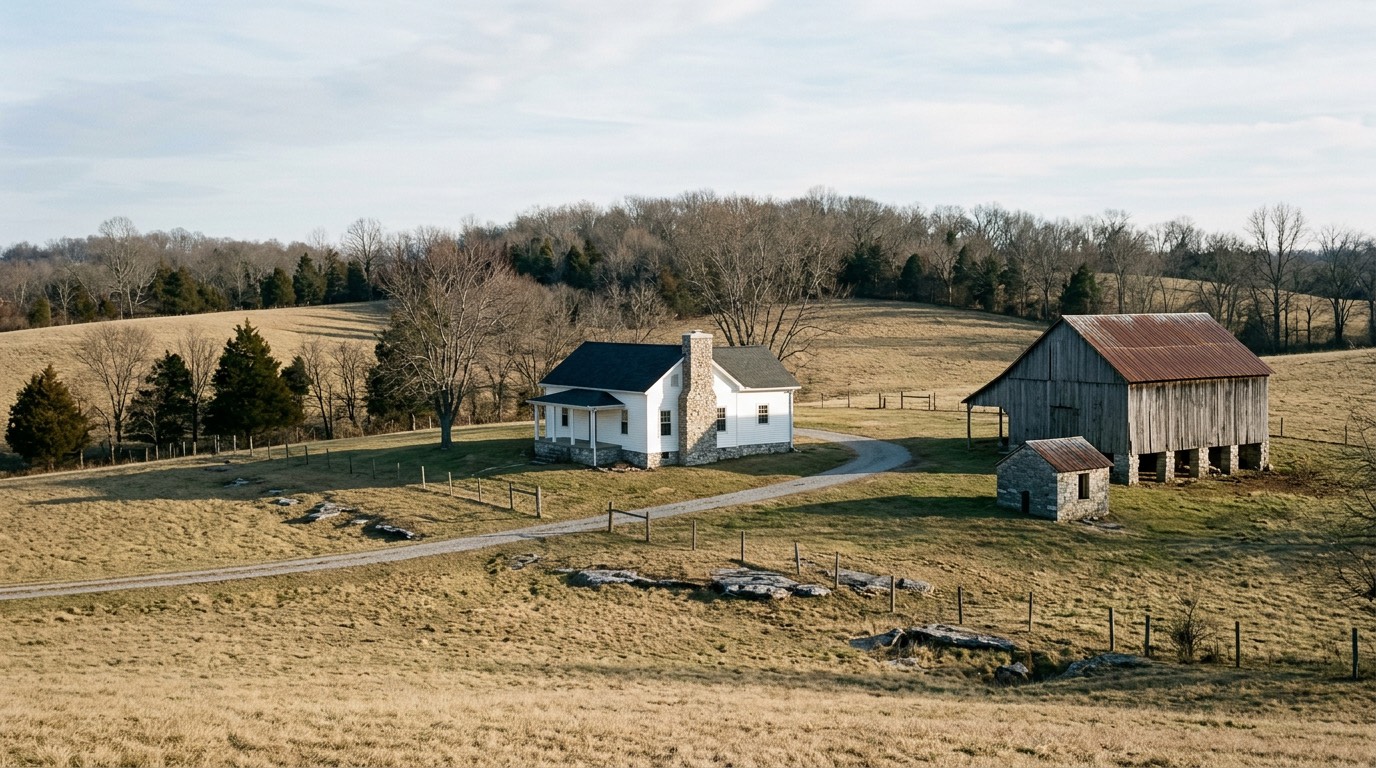
The ground here is not a uniform slab
Middle Tennessee sits on limestone. Rainwater picks up carbon dioxide from the air and the soil, turns mildly acidic, and slowly dissolves that rock along its natural cracks. Do that for a very long time and you get karst: a landscape with caves, springs, disappearing streams and sinkholes.
The USGS maps karst terrain nationally and Middle Tennessee is squarely inside it. This is normal geology for the region, not a local defect, and the vast majority of homes on it sit perfectly still for their whole lives.
But it does change what a mason and a foundation contractor need to think about, because the surface of the rock underneath is not flat and the soil above it is not evenly deep.
Pinnacled rock and why two corners settle differently
Dissolution does not work evenly. It follows joints in the rock, so over time the bedrock surface becomes a set of high pinnacles with deep soil-filled slots between them. On a single house lot the rock can be at the surface at one corner and twenty feet down at the other.
That matters because a footing bearing partly on rock and partly on deep soil has two different behaviors under the same wall. The rock side does not move. The soil side consolidates. What you see above is differential settlement, and in brick it shows as diagonal stair-step cracking through the mortar joints.
This is the most common karst-related masonry problem in Rutherford County by a wide margin, and it has nothing to do with sinkholes.
Want a price for your own wall?
Four quick questions and we come back with a written quote. Or call (772) 251-6654 if that is faster.
Request a quote
Four questions, about a minute. We'll call you back.
Two kinds of sinkhole, and only one is dramatic
Cover-subsidence sinkholes form slowly. Soil filters down into openings in the rock over years, and the ground surface sags gradually into a shallow bowl. You notice it because a low spot in the yard keeps getting lower or a fence line develops a dip.
Cover-collapse sinkholes are the ones that make the news. Soil arches over a void underground until the arch fails, and the surface drops suddenly. These are far rarer than the slow kind and they are what most people picture when they hear the word.
Around Murfreesboro, Smyrna and out toward Christiana and Woodbury, the slow version is what homeowners actually encounter. It is a monitoring situation, not an evacuation.
- A depression in the yard that deepens over seasons
- Water that ponds and then drains away suddenly in one spot
- Trees or fence posts tilting inward toward a common center
- Cracks in a driveway or slab arranged in a rough circle
- A stream or ditch that vanishes into the ground nearby
What karst does to masonry specifically
Brick veneer is a thin, brittle skin over a frame. It has almost no ability to accommodate movement, so it reports foundation behavior honestly and early. Diagonal cracks running up from window and door corners are the classic signal.
Chimneys are worse, because they concentrate a lot of weight on a small footing. A chimney is often the first thing on a house to reveal that the soil below is consolidating into a slot in the rock.
Retaining walls face a different version of the problem. Karst moves water underground in defined channels rather than spreading it evenly, so a wall can receive concentrated flow at one point after a storm while the rest stays dry. That single wet spot is often where a wall starts to bulge.
Water is the part you control
Karst processes take geological time, but the human contribution runs on a much shorter clock. Concentrating water into one spot on a lot accelerates soil piping into rock openings dramatically, and roof drainage is the usual culprit.
A downspout discharging at the foundation is the single most common accelerant. A leaking water line or sewer lateral is the second, and it is worse because it runs year round. Poor grading that ponds water against a wall does the same job more slowly.
None of this is fear selling. It is the cheapest available insurance on a house in this county, and it costs a Saturday and some extension pipe.
- Run downspouts well away from the foundation and check they still do
- Grade soil to fall away from walls in the first several feet
- Repair leaking exterior spigots, irrigation and utility lines promptly
- Avoid creating new low points where water can pond and stand
- Watch where a new patio or driveway sends its runoff
Building on it, which people do every day
Plenty of solid masonry work goes up across Rutherford County on karst without incident. What changes is the front end of the job. On a new footing or a substantial retaining wall, knowing where the rock is before pouring is worth more than any repair method afterward.
That is a geotechnical question, not a masonry one. A mason can tell you what the wall needs. A geotechnical engineer tells you what is under it, and on a lot with visible sinks or highly variable rock, that report is money well spent.
Where rock shows up shallow and uneven, the usual answers are stepping the footing, deepening it to bear consistently, or bridging a soft zone with a designed element. All of them are ordinary work here.
If you think you have one
Start by writing down what you can measure. Photograph the depression with something in frame for scale, mark its edges with stakes, and note the date. A depression that has not changed in a year is a very different thing from one that has doubled.
Do not fill an active sink with soil and call it done. That can hide the process while it continues underneath, and it takes away the only evidence you had.
For anything involving the house itself, get a licensed engineer to look before a repair contractor does. Insurance treatment of sinkhole activity in Tennessee varies by policy, so read yours and ask your carrier directly rather than relying on what a contractor tells you it covers.
- Photograph and stake the depression, and date the record
- Keep vehicles and equipment off it until somebody has looked
- Call a geotechnical or structural engineer before a repair sales visit
- Ask your insurer in writing what your policy addresses
- Report anything affecting a road or right of way to Rutherford County
Related questions
Does living on karst mean my house will crack?
No. Most homes across Middle Tennessee sit on karst and never develop a structural problem. The geology raises the odds of uneven support compared with a region of deep uniform soil, which is why local builders pay attention to footings. It is a design consideration, not a prediction.
How do I tell normal settlement from sinkhole activity?
Normal settlement shows up in the structure and stops. Sinkhole activity usually shows up in the ground first, as a depression that keeps deepening, and it often accelerates rather than easing off. Continuing movement combined with a visible ground depression is the combination that warrants an engineer.
Can a mason fix cracks caused by ground movement?
A mason can repair the masonry once the movement has stopped, and repointing or rebuilding a cracked section is straightforward work. What no mason can do is stop the cause from the outside. If the ground is still moving, the same crack comes back, which is why the sequence matters.
Are some parts of Rutherford County worse than others?
Karst features are unevenly distributed, and the pattern does not stop at a county line. The same limestone runs south past Shelbyville and east toward Lebanon, and two lots on one street can differ more than two towns do. Regional mapping exists, but the resolution is coarse and no map tells you what sits under one particular lot. For a specific property a site investigation is the only reliable answer. Treat the maps as background, not a verdict on your address.
Should a retaining wall be designed differently on karst ground?
The wall itself is standard, but the drainage assumptions change. Underground water arrives along preferential paths rather than evenly, so outlets need to handle concentrated flow and the base needs consistent bearing. On anything tall or carrying a load above, get it designed rather than estimated.
Does a spring on my property mean trouble?
Springs and wet weather seeps are ordinary in this landscape, and plenty of properties around Rutherford County have carried one for generations without trouble. What matters is where the water goes after it surfaces. Route it away from footings, slabs and any wall backfill, and it stays a feature of the place rather than a problem with the house.
More guides
All guides →A Leaning Chimney: What the Tilt Is Telling You
Most leaning chimneys around Murfreesboro are not falling over this week. But the lean is a symptom, and the thing to work out is whether it is finished moving or still going.
ReadBuilding on Rock: Limestone Footings in Rutherford County
Around here the rock is often close enough to the surface that a shovel finds it. Good for what sits on it, complicated for what has to go through it, and it changes how any wall gets started.
ReadLintels: What Holds the Brick Up Over Your Windows
Every window and door in a brick wall has something spanning the gap above it. On most homes in Rutherford County that something is a piece of steel, and steel in a wet wall does not sit still.
Read Hiring
Red Flags When Hiring Someone to Work on Your Brick
The trouble with masonry is that the work you paid for gets buried the moment it is finished. These are the patterns worth slowing down over, and what to ask in each case.
ReadHiringWhat a Masonry Warranty Really Covers
A masonry warranty is a promise about workmanship, not a promise that the ground under your house will stop moving. Knowing the difference is how you read one quote against another.
ReadStraight answer on your wall.
Call, or send the form and we will get you a written price.