Stair-Step Cracks in Brick: Reading What the Wall Is Telling You
A diagonal crack that steps through the mortar joints is the wall reporting movement below it. The pattern, the direction and the width all mean something specific.
The pattern is the diagnosis
Walk the outside of enough houses in Rutherford County and you start seeing the same crack. It runs diagonally, usually up from a corner or away from a window, and instead of cutting straight it steps. Across a joint, up a joint, across, up. People call it a staircase crack because that is exactly what it looks like.
That shape is not decoration. It is the wall telling you that one part of it moved relative to another part, and that the movement happened slowly enough for the crack to follow the path of least resistance. Everything useful about diagnosing these cracks comes from reading the pattern rather than measuring the width and panicking.
Why the crack follows the joints instead of the brick
Mortar is deliberately weaker than the brick it holds. In a properly built wall the joint is the sacrificial part, the piece designed to give up first so the expensive units survive. When a wall is pulled apart by movement below, the failure runs through the mortar because that is where the wall is weakest.
So a clean stair-step crack through the joints is, oddly, the better version of this problem. It means the mortar did its job. When the crack instead splits straight through brick after brick, the mortar was harder than the brick, or the force was fast and large enough that nothing had a choice. Cracks through the units themselves get taken more seriously than cracks through the joints.
Want a price for your own wall?
Four quick questions and we come back with a written quote. Or call (772) 251-6654 if that is faster.
Request a quote
Four questions, about a minute. We'll call you back.
Clay soil and the Middle Tennessee wet and dry cycle
Most of the stair-step cracking around Murfreesboro traces back to soil. The clays here shrink when they dry out and swell when they take on water. A long August drought pulls moisture out of the ground and the soil contracts. A wet spring puts it back and the soil expands. The footing sitting on that soil goes along for the ride.
The movement is not uniform, and that is the whole problem. One corner of a house sits under a downspout that dumps at the foundation and stays wet. Another sits under a wide eave and a big shade tree pulling moisture out of the ground all summer. Different corners move different amounts and the wall between them has to absorb the difference.
There is a second factor here that is genuinely local. Middle Tennessee sits on limestone with karst features, so rock depth can change dramatically across a single lot. A footing bearing partly on shallow rock and partly on deep clay is a footing with two different personalities, and the wall above it often shows a crack right where they meet.
Reading the direction and the shape
Direction tells you which side dropped. A stair-step crack that widens as it goes up is pointing at a corner or a section that has settled downward, dragging the wall with it. A crack that is wider at the bottom than the top usually means the opposite, that something below is being pushed up or that the center of the wall has stayed put while an end went down.
Location matters just as much, because openings and junctions are where any masonry wall is weakest.
- Widening upward, a settling corner or end of the wall
- Widening downward, heave or a dropped middle section
- Off a window or door corner, stress concentrating at the opening
- At the junction of an addition and the original house, differential movement
- Mirrored on the inside of the house in drywall, movement rather than surface cracking
Which cracks are watched and which are acted on
Plenty of stair-step cracks are old news. A house that moved in its first few years and then stopped can carry a hairline crack for decades without anything else happening. Filling that crack is cosmetic maintenance, not repair, and there is nothing wrong with treating it that way.
The signals that change the conversation are movement in the present tense and any sign the wall is no longer flat. A crack that opens visibly between seasons, doors that used to latch and now do not, a wall face that has started to bow outward, or brick that has shifted so the wall is no longer in one plane. Those are structural questions and they belong to an engineer before they belong to a mason.
- Hairline, unchanged over years, dirty inside from age, generally monitored
- Opening and closing with the seasons, monitored closely with dated measurements
- Steadily widening in one direction, evaluated by a structural engineer
- Wall bulging, brick out of plane or a step you can feel with your hand, urgent
- Cracked brick units rather than cracked joints, evaluated rather than patched
How to monitor a crack properly on your own
You do not need equipment to do this well, you need discipline. Pick the widest point of the crack and mark it with a pencil line across both sides. Measure the gap with a ruler, or slide a coin or a drill bit in and note what fits. Photograph it with something in frame for scale and write the date on the photograph.
Then do it again after the next hard freeze, after the spring rains and at the end of a dry August. Those three moments cover the full range of what the soil does here in a year. A file of dated photographs is worth more to a mason or an engineer than any verbal description, and it costs you nothing but a calendar reminder.
What an honest repair actually involves
The order matters. Water management comes first, because most soil movement here is really water movement. Gutters that discharge well away from the house, downspout extensions, grade that falls away from the wall, and no flowerbed berm trapping water against the foundation. This work is cheap compared with masonry and it addresses the cause.
Once movement has been stabilized or shown to be dormant, the crack itself is repaired by cutting out the damaged mortar along the crack, replacing any cracked brick, and repointing with a mortar matched to the original. Smearing sealant across the face of a stair-step crack is not a repair. It traps water in the joint, it looks like a scar, and it hides the one thing you wanted to keep watching.
If the footing genuinely needs support, that is a separate trade and a separate scope. Piers and underpinning are engineering work. Any masonry contractor who quotes a structural fix without an engineer's involvement is selling you something they cannot stand behind.
Related questions
Is a stair-step crack always a foundation problem?
No. Thermal movement in a long wall with no expansion joint does it. So does a rusting steel lintel swelling over an opening, and so does a corner that settled once decades ago and has sat still ever since. There is a local cause on the list as well. Limestone under Middle Tennessee lies at wildly different depths across a single lot, so a footing can rest on hard rock where it starts and on deep soil where it ends, and the wall above tends to crack right where those two meet. The pattern shortens the list. Looking over the whole house, inside and out, finishes it.
How wide is too wide?
Width on its own is a weak test. A quarter inch crack that has not changed in ten years is less worrying than a hairline that doubled since March. Change over time is the measurement, which is why dated photographs beat a single ruler reading. Take them at the two extremes a Rutherford County year actually has: the end of a dry August, when the clay has pulled away from the footings, and again once spring rain has swollen it back. If you can see daylight through a crack or feel a step across the face with your hand, stop measuring and get it looked at.
Should I fix the crack before I sell the house?
Repointing a crack cosmetically without addressing movement is visible to any competent inspector, and it reads as a cover up even when it is not. It is usually better to fix the drainage, repair the masonry properly, and keep the documentation. A clean paper trail is worth more in a negotiation than a fresh smear of mortar.
Why did the crack appear after a dry summer?
Because clay soil shrinks as it dries and the ground under part of the footing drops away. Long droughts are one of the most common triggers for new cracks in Middle Tennessee, and trees close to the house make it worse by drawing moisture out of the soil. Some of those cracks partly close again when the ground rehydrates.
Can I just caulk it myself?
Flexible sealant belongs in a control joint, not in a mortar joint. In a brick wall it seals water into the joint, prevents the wall from drying, and creates a shiny line that does not weather in. If the crack is stable and cosmetic, have it cut out and repointed with matched mortar instead.
Do I need an engineer or a mason first?
If the wall is flat, the crack is small and nothing inside the house has changed, start with a mason. If the wall is bowing, brick are out of plane, doors are sticking or the crack is clearly growing, call a structural engineer first. An engineer's report also gives you a scope that makes contractor bids genuinely comparable.
More guides
All guides →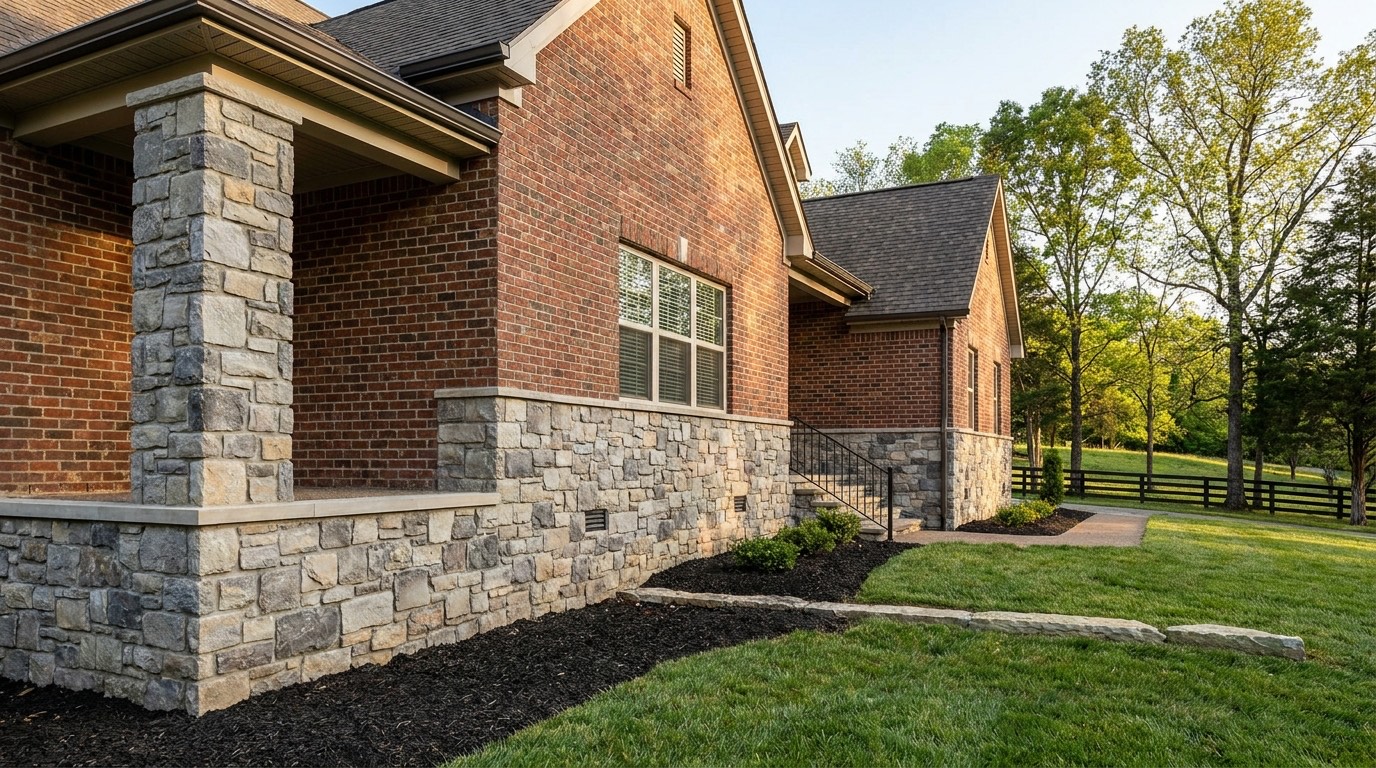 Cost guide
Stone Veneer Cost in Tennessee: What Moves the Number
Two stone veneer bids on the same Murfreesboro house can differ by half. Almost always the gap sits in three places: which stone, what is behind it, and how many hours the pattern takes to set.
Read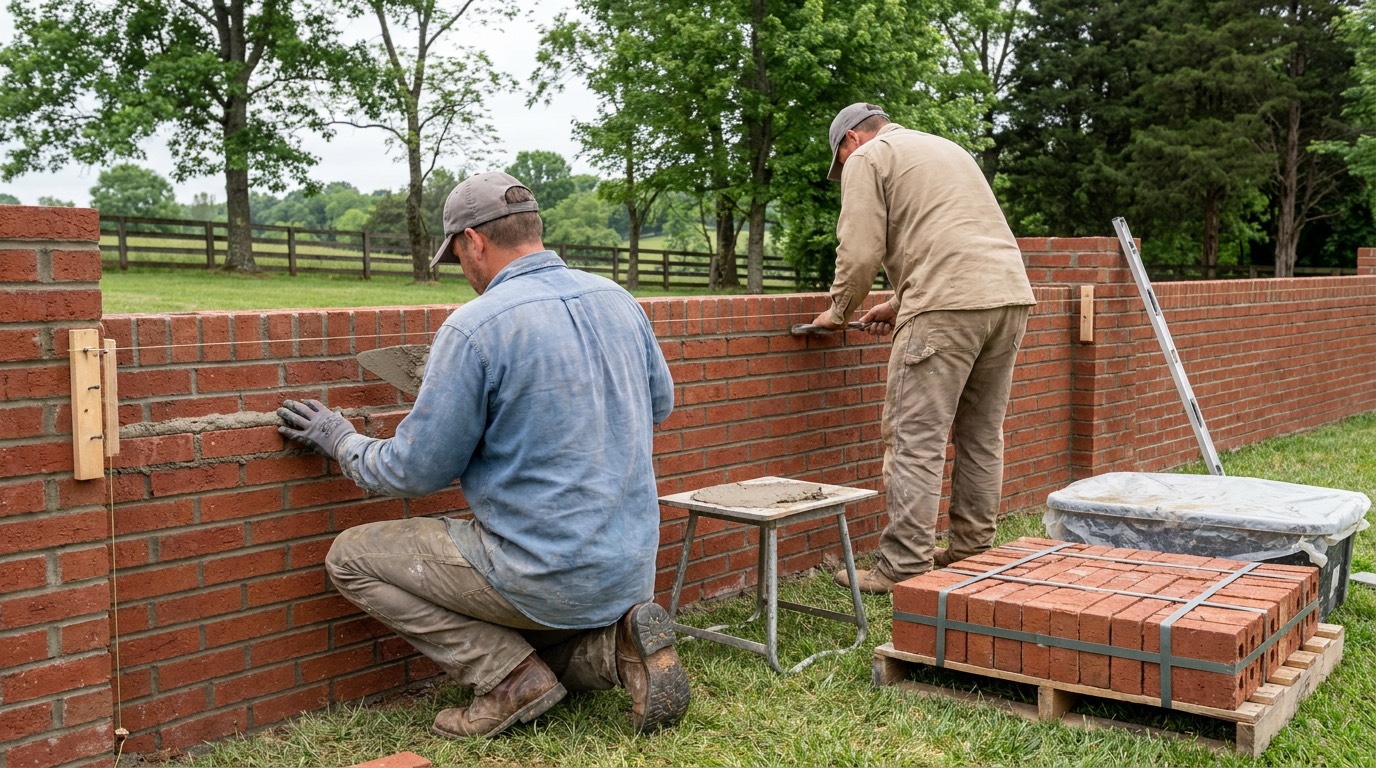 Hiring
Tennessee Licensing and Masonry Work: What It Covers and What It Does Not
Nobody in Tennessee holds a license that says mason on it. Knowing what the state license does cover, and what it never covers, changes the questions you ask.
ReadLocal guideTennessee Fieldstone or Shipped In Stone: Choosing for a House Here
The stone that comes off a Rutherford County fencerow and the stone on a pallet from three states away behave differently on a wall. Both have their place. Here is how to pick.
ReadWhat Tuckpointing Costs in Rutherford County, and What Moves the Number
Two brick walls the same size can hold very different amounts of mortar joint, which is why the same square foot of wall is not the same amount of work.
ReadWater in a Basement Block Wall: Fix the Outside First
Most wet block walls are fixed in the yard, not the basement. Here is how to read what the wall is telling you, and the outside work that belongs before any coating goes on.
ReadStraight answer on your wall.
Call, or send the form and we will get you a written price.