Tennessee Fieldstone or Shipped In Stone: Choosing for a House Here
The stone that comes off a Rutherford County fencerow and the stone on a pallet from three states away behave differently on a wall. Both have their place. Here is how to pick.
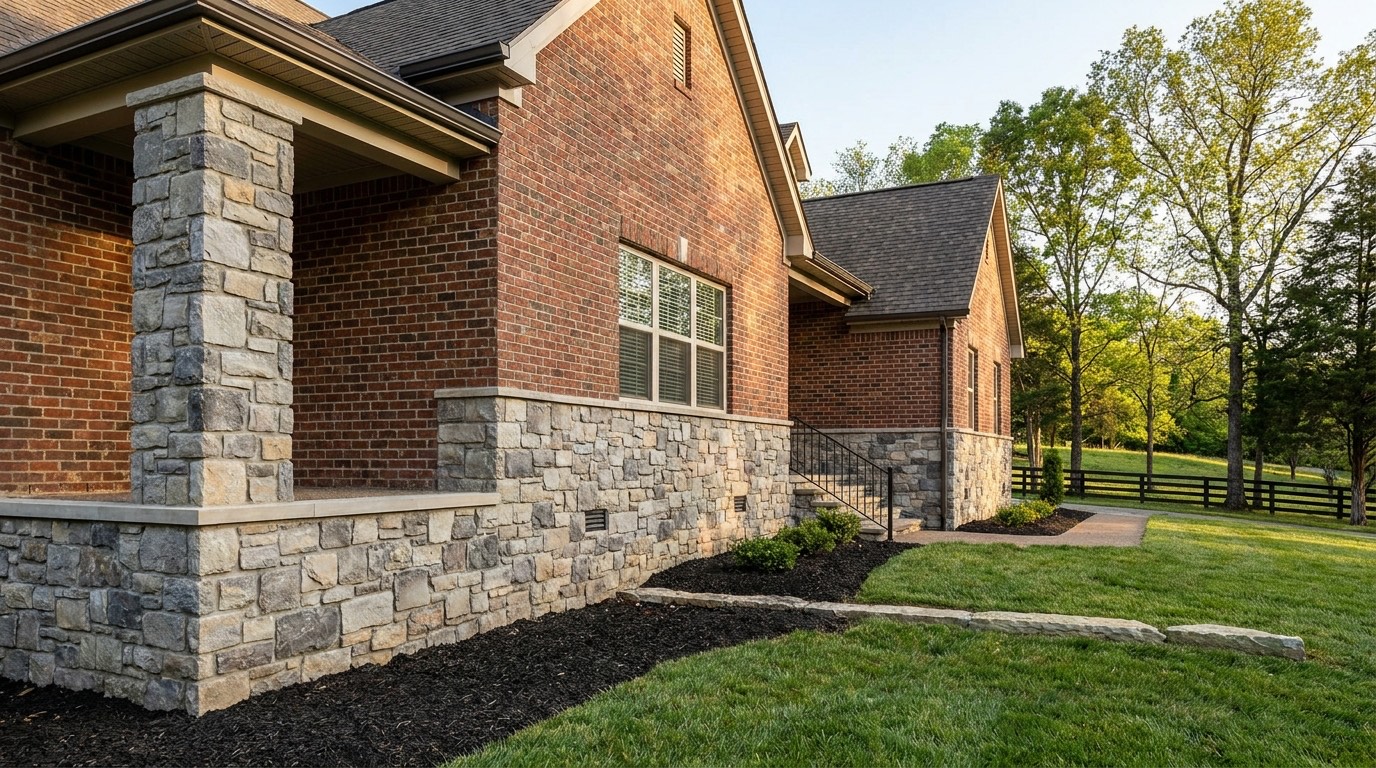
What people mean when they say Tennessee fieldstone
Ask ten people in Middle Tennessee what fieldstone is and you get ten answers. In practice it means limestone that came off the surface of the ground rather than out of a saw. Farmers pulled it out of fields for two centuries and stacked it into fencerows, and a lot of what gets laid today has the same origin or comes from a quarry ledge broken to look like it does.
The look is specific to this region. Weathered gray and buff faces, some with rust and moss tones, irregular thickness, and edges shaped by weather rather than by a blade. The dry laid walls you pass on back roads toward Christiana and Woodbury are the reference, and it is a look nobody manufactures convincingly.
Where it comes from and what that does to supply
Rutherford County sits on limestone. It is under your feet, in the road cuts on the way to Shelbyville, and it is why quarries and stone yards here are close and numerous. That proximity does two useful things. Freight on a stone pallet is a real cost, and a load coming forty miles carries less of it than a load coming eight hundred. And you can go put hands on the material before you commit.
The catch is that natural local stone is a natural product. What is on the yard this month may not match what is there in the fall, sizing runs wider, and a big job can clean out a color you liked. If your project is phased, or you expect to extend a wall in two years, buy it all at once or accept that the second phase will read slightly different.
Want a price for your own wall?
Four quick questions and we come back with a written quote. Or call (772) 251-6654 if that is faster.
Request a quote
Four questions, about a minute. We'll call you back.
What shipped in stone buys you
Stone arriving from out of state is not a compromise. It is a different set of tradeoffs, and sometimes the right one.
You get consistency, because a company selling nationally sorts and grades, so pallet two looks like pallet one. You get sizing, since squared and cut stone in uniform bed heights lays faster and gives a tighter, more formal wall. You get colors and textures the local ground simply does not produce, whether that is a warm gold ledgestone or a dark tight blend. And you get availability, which matters when a builder in Smyrna needs the same product on twelve houses across a year. Manufactured stone veneer sits in this category too, made from cast concrete, lighter and cheaper per square foot, with a fixed pattern repeat you eventually learn to see.
Full bed and thin veneer are the bigger decision
Before you argue about origin, settle the thickness. Full bed stone is several inches deep, heavy, and needs a foundation ledge or shelf to carry it plus ties back to the structure. Thin veneer is roughly an inch, adheres over a prepared substrate and carries no load, which is why it can go on a house that was never designed for stone.
Local fieldstone is generally a full bed material, though yards do saw it into thin veneer. Most imported product on new construction is thin. This decision drives the wall system behind the stone, and that system matters more than the rock. Drainage plane, flashing, weeps at the base and around openings, and proper ties are what keep water out of the wall. A beautiful stone job over a poorly detailed substrate fails on schedule, and by then the stone gets the blame.
Freeze thaw is the tiebreaker
Here is the local test that gets skipped. Winter in Middle Tennessee runs through freezing and back repeatedly, and any stone that absorbs water and then freezes will eventually break at the face. This is the single most important difference between working here and working in a warm climate, and it should shape the choice.
Our dense weathered limestone has already survived that cycle in the open for a very long time, which is a useful piece of evidence. Some imported stone is equally durable and some is a softer, more porous sandstone that looks superb on a showroom pallet and spalls after five winters on a north facing wall at ground level. Ask the supplier for the absorption rating and ask specifically whether the product is rated for a freeze thaw region. Then ask where the nearest installed wall of it is and go look at that wall in March, not July.
The cost is mostly labor
Homeowners compare stone by the pallet price, which is the smallest moving part. Material is typically the minority of a finished stone wall. The mason's time is the rest.
Irregular fieldstone takes longer, because every piece is a decision. The mason picks it up, turns it, sets it down, and reaches for another. Squared and gauged stone lays in courses at a much faster rate. That gap in hours is usually larger than any difference in the stone price, which is why a hand shaped fieldstone wall can cost more than an imported product that costs more per square foot. Substrate prep, corners, the number of outside returns, sills and caps, and whether there is scaffolding all move the total as well. Ranges are broad and only a site visit produces a number that means anything.
- Material cost per square foot, plus freight on anything shipped
- Full bed against thin veneer, which changes the whole wall system
- How irregular the stone is, since irregular means slower
- Corner pieces, returns, sills and caps, which are the slow parts
- Substrate prep, drainage plane, flashing and ties
- Access, height and whether scaffolding is needed
How to actually choose
Go to the yard. Photographs lie about stone more than any other material. Look at a pallet in daylight, pull pieces from the middle rather than the display face, and pour a bottle of water over a few of them, because wet stone is what your wall looks like after rain and the color shift can be dramatic.
Then match the choice to the house. A 19th century brick house near the square or a rural property toward Woodbury wants local stone, since anything else reads as applied. A new build in Smyrna or La Vergne with a tight architectural palette may be better served by a consistent shipped product, and if you are in an HOA the architectural committee likely has a say. Get their approval in writing before the pallets arrive rather than after. Last, ask your mason for a small mock up on the actual wall and look at it at morning and evening light before the whole elevation goes up.
Related questions
Is local fieldstone cheaper than imported stone?
Sometimes on material, rarely on the finished wall. Local stone saves freight and is easy to go see, but it is irregular, and irregular stone takes a mason far longer to lay. Labor is the larger share of a stone job, so a cheaper pallet can still produce a more expensive wall.
Will manufactured stone veneer hold up in Tennessee winters?
Quality products from established manufacturers do, provided the wall behind them is detailed correctly with a drainage plane, flashing and weeps. Almost every failure we get called to is water that got behind the veneer rather than the veneer itself giving out. A Middle Tennessee winter is what punishes that: water sitting in a wall through a season that keeps swinging back over freezing will find the bond line and work it loose. Color can fade over many years, more so on south facing elevations.
Can I match stone on an addition to my existing house?
Close, seldom exact, and it helps to say so at the start. Natural stone varies by batch and the existing wall has weathered for years. The usual approach is blending the new material near the transition and, where possible, pulling stone from a less visible part of the original wall to feather the join. If the house is in Brentwood, or in one of the Franklin subdivisions with architectural review, put the mock up in front of the committee before the pallets are ordered. Approving a blend after it is on the wall is a far harder conversation.
How do I tell if a stone will spall in freeze thaw?
Absorption is the practical indicator, so ask the supplier for the rating and whether the product is rated for freeze thaw exposure. Very porous stone that soaks up water fast is the risk, particularly at the base of a wall where splash keeps it wet. Local weathered limestone has already proven itself outdoors here.
Does dry stacked stone need mortar?
A traditional dry laid wall relies on gravity, careful fitting and its own thickness, and it works because it can move and drain. What people usually want today is a mortared wall with the mortar raked back so it reads as dry stacked. Those are two different builds with different foundations and different prices.
What time of year should stonework be scheduled?
Spring through fall, and the constraint is not the stone. Weathered limestone does not care what the thermometer says. Everything holding it to the wall does. A full bed wall is set in mortar, and thin veneer adds a scratch coat and a bond coat on top of that, so a veneer job has more wet material in it than a solid stone wall does. Below roughly forty degrees, which Rutherford County sits under on plenty of winter nights, none of that gains strength without heated materials and an enclosure, and a bond coat that freezes green lets stone off the wall years later. Booking in late winter for early spring work also gets you a better place in the queue.
More guides
All guides →What Tuckpointing Costs in Rutherford County, and What Moves the Number
Two brick walls the same size can hold very different amounts of mortar joint, which is why the same square foot of wall is not the same amount of work.
ReadWater in a Basement Block Wall: Fix the Outside First
Most wet block walls are fixed in the yard, not the basement. Here is how to read what the wall is telling you, and the outside work that belongs before any coating goes on.
ReadWeep Holes: Why Your Brick Wall Is Built to Drain
Every year somebody caulks the gaps along the bottom of their brick to keep bugs out. It works on the bugs. It also traps water in a wall built on the assumption that water gets out.
Read Hiring
What Belongs in a Masonry Quote Around Murfreesboro
A masonry quote is really a specification, and the price is only the last line of it. When the specification runs one sentence long, there is nothing there to compare.
ReadGetting a Chimney Ready Before the First Hard Freeze
The deadline for chimney work here is the first sustained freeze, not the first fire. Everything on this list is about one thing: how much water is inside the masonry when the temperature drops.
ReadStraight answer on your wall.
Call, or send the form and we will get you a written price.