What Belongs in a Masonry Quote Around Murfreesboro
A masonry quote is really a specification, and the price is only the last line of it. When the specification runs one sentence long, there is nothing there to compare.
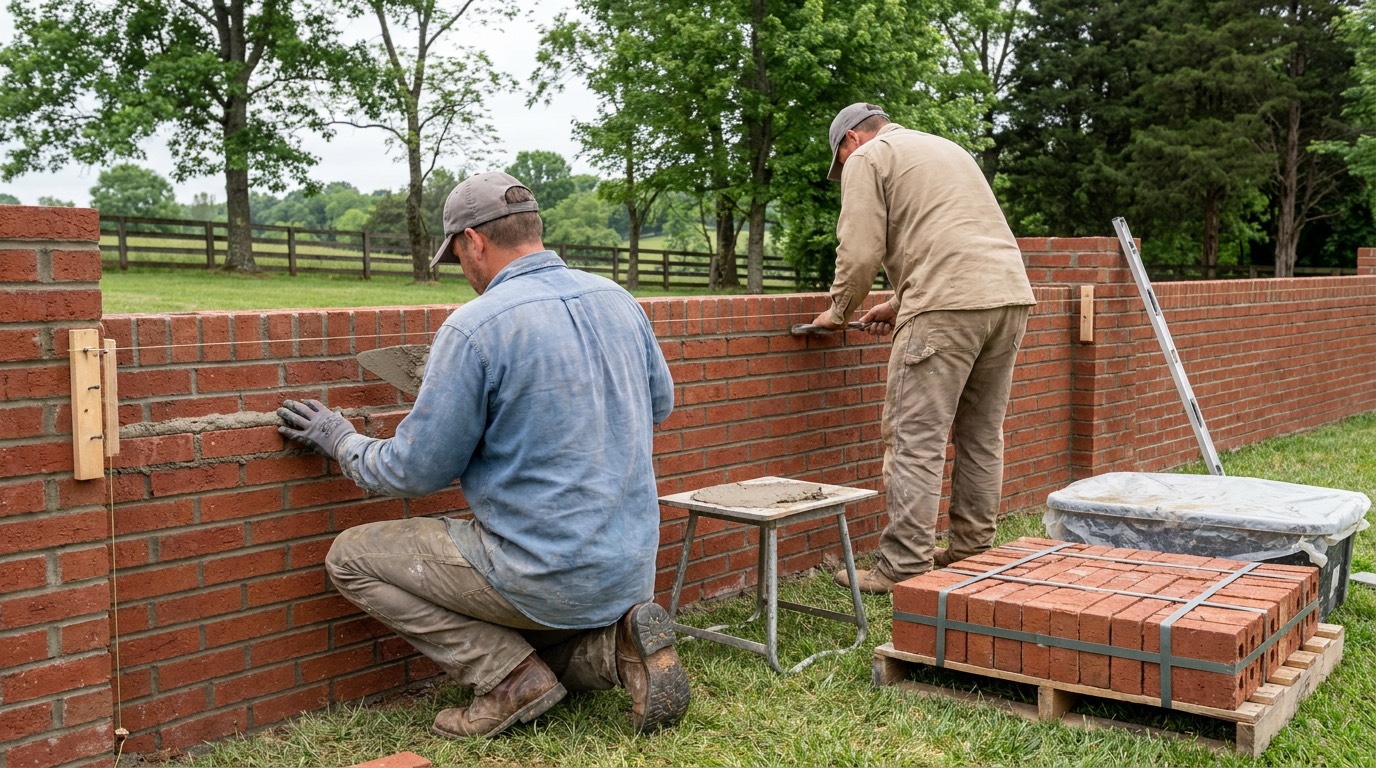
Start with the count, because everything hangs off it
Masonry gets measured three ways depending on the work, so the first thing to find is which unit the price was built on and what the number was. Repointing is priced by linear foot of joint. A rebuild goes by square foot of elevation or by brick count. Chimney work is usually courses, or a stated height above the roofline.
That number carries the rest of the page. Without it, two bids cannot be laid against each other, a change order has nothing to be measured against, and the crew arriving Monday works from the same fog you do.
Joint footage and wall area are not the same measurement and do not convert. Standard modular brick carries far more joint per foot of elevation than oversized units, which is how two houses that look alike from the street price apart for identical work.
How the brick or stone gets matched
On any repair to an existing wall, matching is the hardest thing on the job, and the document should say how it gets handled. Color, size, texture and the sand in the mortar all have to line up, and brick that has spent forty years in the Tennessee weather does not look like the same brick new.
There are only a few honest approaches, and a good quote names one. Salvage brick from a hidden elevation and use new brick there. Source a close current product and accept a stated degree of difference. Or find reclaimed stock, which takes time and costs more.
Silence on this point does not make the question go away. It means whoever holds the trowel that morning decides for you, scaffold already up.
- Where matching units are coming from, and whether salvage is planned
- Whether a sample panel will be built for you to approve first
- Who decides if the match is acceptable, and at what stage
- What happens if the sourced product turns out not to match
- For historic brick, that the replacement is a soft period match
Want a price for your own wall?
Four quick questions and we come back with a written quote. Or call (772) 251-6654 if that is faster.
Request a quote
Four questions, about a minute. We'll call you back.
Why the mortar type gets written down
The mortar belongs on the page by name. Type N, S or O, or a described mix, plus the sand and the color. ASTM C270 is the standard that defines the types, and on a wall with age in it the choice is not preference.
The rule that surprises people is that stronger is usually wrong. Mortar is meant to be the sacrificial element, softer than the brick around it, so that movement and freeze-thaw break the joint instead of the unit. Hard modern mortar in a soft nineteenth-century wall around the Murfreesboro square destroys brick faces, and the damage cannot be undone.
Tooling profile needs naming too. Concave, weathered, raked and grapevine shed water differently and read differently from the sidewalk, so matching the existing profile is labor, and labor gets priced.
Reaching the wall, and the silica dust nobody mentions
Getting a crew up to the wall is a real cost. A ladder job, a pipe scaffold job and a lift job are three separate prices, and on a second-story elevation the way up can matter more to the schedule than the brickwork does.
Protection needs stating too. Where the mixer and sand pile go, how the drive stays clean, what covers the plantings, where the rinse water ends up. Mortar slurry that sets on a concrete drive becomes its own removal job.
Grinding is what homeowners are never warned about. Repointing means cutting old mortar out with an angle grinder, which throws a great deal of fine silica dust. Ask what controls it. Vacuum shrouds and water suppression are equipment and time, and a bidder who left them out has not priced the same job.
- Whether ladders, scaffold or a lift is planned, and how each one is priced
- What is covered: plantings, walks, the drive, windows and the HVAC unit
- Dust control while grinding runs, and whether windows are sealed first
- Where brick is stacked and where mortar gets mixed on your lot
- Daily cleanup, debris haul-off, and whether the crew works off your hose and outlets
The weather clause, which matters more here than most places
Mortar work generally stops below about forty degrees unless the work is enclosed and heated, and Middle Tennessee gets real cold snaps from December into February. A quote written for Rutherford County should carry a sentence about what happens if one of those lands mid-job.
The reasonable version states a cold-weather protection approach and whether that sits inside the price or gets billed on top, plus an expectation that days will be lost. The unreasonable version is a fixed completion date in January with no mention of temperature.
Wet weather deserves a line too. Fresh joints need protecting from spring rain, and a wall left uncovered before a storm loses a day of work.
Exclusions, the rock underneath, and what nobody can see yet
Read the exclusions first. That paragraph is the contractor stating plainly where their work stops, which is the same as stating what moves onto your list.
On masonry jobs the usual ones are flue liners and chimney caps, roof flashing, gutter work, wood framing behind a veneer, structural engineering, painting, and permits. None of that is unfair to exclude. It becomes a problem only when it goes unsaid. Schedule exclusions count too, which is where an HOA belongs. In Smyrna and La Vergne an architectural committee can hold a three-day job for weeks, so name who submits for approval and say the start date moves with it.
Rock is the other one. Limestone sits shallow and unevenly across Rutherford County, and one footing can land on solid ledge at one end and clay at the other. It is the change order that turns up here more than any other, so a quote with no rock contingency was not written for this ground. Workable versions name an included depth and a unit rate past it, or say work stops, photographs come to you, and nothing continues without a signed change order.
- A written exclusions list instead of a general disclaimer
- A rock clause: what depth or quantity is carried, plus the unit rate beyond it
- Who submits for HOA architectural approval, and how the start date moves
- Permits: pulled by the contractor, left to you, or judged not required
- The change order route, agreed in writing before the crew mobilizes
Terms, warranty, and the six-row comparison
Payment terms should read as a sequence. A modest amount at the start covers the brick order and the scaffold booking. After that, money moves as each stage finishes and you can see it finished. The balance waits until the wall has been walked with the mason. Warranty length and exclusions belong in the document, not in conversation.
Verify the contractor yourself. This state issues no masonry-specific license, so what you check is the general contractor license, which the Tennessee Board for Licensing Contractors requires once a job passes a stated project value. Confirm that value and the license status with the Board rather than the contractor. Ask that the certificate of insurance reach you straight from the insurer.
Then run the comparison as a table. Six rows: count and unit, grind depth or rebuild extent, mortar type and tooling, the matching plan, the route up the wall, and what is carried for rock. Fill a column from each bid. The gap between totals almost always sits in one row, and once you see which row, you are picking a plan rather than a price.
Related questions
Does a short quote mean a bad contractor?
Not on small work. One page can cover a few square feet of veneer rebuild completely. The worry is whole-house repointing set out in two lines. Around Rutherford County a short quote still owes you two lines most bidders skip: what the crew does when a footing hits limestone, and what the schedule does in a cold snap. Page count is not the measure.
Is repoint as needed a real scope?
Not by itself. There is nothing to compare it against and no baseline for judging extra work six weeks in. Ask for measured joint footage plus a rate per foot. Where the extent honestly cannot be seen until joints are open, the instrument for that is an included quantity with a stated rate beyond it.
Should the quote break out labor cost from material cost?
Usually no, and pushing on it tends to be the wrong argument. Masons build a number from the scope rather than a cost sheet, and the margin inside it is their own affair. What you are owed is a plain description, the count it rests on, and a per-unit price for work added after signing.
How many quotes should I get?
Three is a sensible number for anything substantial. Fewer gives you no sense of the range, and more produces noise rather than clarity. Make sure all three price the same scope, or you are comparing three different jobs and the cheapest is simply the smallest.
Does the quote have to cover permits?
It has to say who is pulling one and whether that cost sits inside the number. Whether masonry work needs a permit turns on what is being done and on where the house sits, and Murfreesboro, Smyrna, La Vergne and unincorporated Rutherford County do not all handle it the same way. Ask which office the contractor plans to file with, then call that office yourself.
Can a masonry quote expire?
Yes, and a stated expiry is ordinary. Brick pricing moves, and a mason holding calendar space cannot hold it forever. Season matters here as much as the paper does. A price quoted for October work does not automatically survive into January, when Middle Tennessee drops under the temperature mortar needs and the crew has to tent and heat to keep going. Ask what a delay into winter does to the number before you sit on the quote.
More guides
All guides →Getting a Chimney Ready Before the First Hard Freeze
The deadline for chimney work here is the first sustained freeze, not the first fire. Everything on this list is about one thing: how much water is inside the masonry when the temperature drops.
ReadChecking Masonry After a Tornado: Safety, Signs, Records
Tornado damage to masonry is different from ordinary storm damage. It moves things. This is what to check, what to keep your distance from, and what to photograph before anyone starts cleaning up.
Read Maintenance
The Annual Masonry Walk-Around Any Homeowner Can Do
You are not diagnosing anything. You are building a record, so that next year you can tell what moved and what has been sitting still since the house was built.
ReadSeasonalThe Real Masonry Season in Middle Tennessee
Unlike trades in the Sunbelt, masonry in Rutherford County has a genuine season. Here is how each part of the year behaves, and why winter is a slowdown rather than a shutdown.
ReadWhat Brick Repair Costs in Murfreesboro, and What Moves the Number
Brick repair is priced off joint count, brick match and how a crew reaches the wall, not off the damage you can see from the driveway. Here is the frame homeowners around Rutherford County run into.
ReadStraight answer on your wall.
Call, or send the form and we will get you a written price.