Checking Masonry After a Tornado: Safety, Signs, Records
Tornado damage to masonry is different from ordinary storm damage. It moves things. This is what to check, what to keep your distance from, and what to photograph before anyone starts cleaning up.
First, the things not to walk up to
Middle Tennessee gets tornadoes. When one has been through your neighborhood, the immediate risk from masonry is not water or long term deterioration. It is weight coming down.
Brick and stone are heavy and they fail without warning once displaced. A wall standing at an angle is not stable, it is balanced. A chimney with brick knocked out of one side is holding itself up on whatever is left. Both can come down in a gust, or when someone leans a ladder against them.
The working rule is to stay back at least the full height of any masonry element you are unsure about, and to keep others back too. Nothing on the rest of this list is worth getting close for.
- A wall, chimney, or column visibly leaning or out of line
- Masonry with brick missing from one face or a hole punched through it
- Any wall with debris leaning against it or a tree resting on it
- A freestanding or retaining wall with soil washed out at the base
- Anything above you on a roof, including a chimney you cannot see clearly
Why tornado damage looks different
Ordinary severe weather works on masonry through water. Wind driven rain finds openings, saturates the wall, and the damage shows up over months. Tornado damage is mechanical and immediate.
Three things happen. Pressure differential and wind load push laterally on a wall that was designed mostly to carry weight downward. Flying debris strikes at speed, which is what punches individual bricks out or shatters a section of veneer. And the frame of the house itself can rack slightly, which moves the veneer attached to it.
That last one is the sneaky category. A house can look almost untouched, with the roof intact and the windows in place, while the brick veneer has been shifted enough that its connections to the frame have let go.
Want a price for your own wall?
Four quick questions and we come back with a written quote. Or call (772) 251-6654 if that is faster.
Request a quote
Four questions, about a minute. We'll call you back.
The chimney is usually the first casualty
A masonry chimney sticks up above the roof with no lateral support and considerable mass at the top. In a tornado it is the most likely masonry element on the house to move, and the most dangerous one when it does.
Look at it from the ground, from a distance, with binoculars. Compare it against a vertical reference, a corner of the house or a door frame in the background. You are looking for lean, for a step or offset partway up the stack, and for a gap opening between the chimney and the wall of the house.
Do not climb up to look. Do not light a fire in it. Even a chimney that stayed upright can have a cracked flue liner or a shifted section inside, and neither is visible from outside.
Brick veneer: what the cracks are telling you
On most homes around Smyrna, La Vergne, and newer Murfreesboro subdivisions, the brick is a veneer. It is a single wythe of brick standing on the foundation ledge and tied back to a wood frame with metal ties. Those ties are what wind load tests.
Fresh damage looks different from the slow cracking you may already be used to seeing. Storm cracks are clean and unweathered, with sharp edges and no dirt in them. They often run in horizontal or diagonal bands rather than following the usual stair step pattern of settlement.
The more important check is whether the wall is still flat. Sight down the length of the wall from one corner, eye close to the brick. A bulge, a wave, or a section standing proud of its neighbors means ties have failed behind it, and that is a structural condition rather than a cosmetic one.
Everything that is not attached to the house
Freestanding masonry has no frame to lean on and often no engineering behind it. It moves in storms that leave the house alone, and it is easy to overlook while you are focused on the building.
Walk the property once the weather has fully cleared and look at each piece in turn.
- Garden and privacy walls: lean, cracking through the middle courses, displaced caps
- Columns and pillars at gates or porches: any rotation or offset at a joint
- Retaining walls: new bulging, opened joints, or soil and gravel pushed out at the base
- Outdoor fireplaces and kitchens: movement at the footing, cracks through the firebox
- Mailbox surrounds and low walls near the road: struck by debris more often than people expect
Document before anything gets cleaned up
The single most useful thing you can do in the first day is build a record, and the time to do it is before debris gets moved and before any repair starts.
Photograph in three ranges. Wide shots that place the damage on the house and show the surrounding context. Medium shots of each damaged element. Close shots with something for scale beside a crack or a hole. Include the undamaged sides too, because a claim conversation often turns on what was and was not affected.
Write down the date and time. Keep any prior photos of the same walls, since an adjuster will reasonably ask what was pre existing, and dig out paperwork from past masonry work. Coverage is between you and your carrier, but a clear record makes every following conversation shorter.
Stabilize now, repair properly later
Temporary measures are worth taking and worth understanding as temporary. Tarping an opening, fencing off a leaning wall, and shoring what has to stay standing all buy time. None of them are repairs, and an open wall left through a Tennessee winter takes freeze-thaw damage on top of the storm damage.
Bring in a structural engineer when masonry is out of plumb, when a load bearing element has moved, when a chimney has shifted at the roofline, or when your insurer asks for one. A mason can tell you what a wall looks like. An engineer is who signs off on whether it is safe and what has to happen next.
Storm work pulls crews into a neighborhood within days, and the ones that leave again with the weather often carry neither a license nor a policy. Masonry carries no license of its own in Tennessee, so there is nothing of that sort to be shown at your door. What you are checking is the state contractor license, required above a certain job value and administered by the Tennessee Board for Licensing Contractors, so call them and check it against the name on the estimate yourself. A card handed to you across a truck bed proves nothing, and the week after a tornado is exactly when nobody feels they have time to look. Ask for the insurance certificate to come from the carrier too, because an uninsured crew climbing a damaged wall on your property has moved their risk onto you.
Related questions
The house looks fine but the brick has new cracks. Is that structural?
It might be, and it is worth checking properly rather than guessing. Fresh clean cracks in veneer after a tornado suggest the wall took lateral load. The deciding test is whether the wall is still flat and plumb. If a section bulges or waves when you sight along it, the ties behind it have likely failed and that needs a professional look.
Can I still use the fireplace after a tornado?
Not until the chimney has been inspected. A stack that looks straight from the yard can have a cracked flue liner or a shifted joint inside, and a damaged flue can let combustion gases into the house. Have both the flue and the masonry checked before the first fire, even if nothing looks wrong from the ground.
Should I clear the debris before the adjuster comes?
Remove what is genuinely a hazard and photograph everything first. Beyond that, leaving the scene as it is until it has been documented and seen usually helps. If something must be moved for safety, take pictures of it in place from several angles before it goes anywhere.
A contractor knocked on my door offering to start today. Should I?
Slow down. Storm chasing crews follow severe weather into an area and leave with it. Ask for a written scope of work, check licensing with the Tennessee Board for Licensing Contractors yourself, and be wary of large cash payments before work begins. A local mason who will still be in Rutherford County next year is worth waiting a few days for.
How do I know if I need a structural engineer?
Call one when masonry has moved rather than merely cracked: a wall out of plumb, a chimney leaning or offset, a load bearing element displaced, or a foundation wall that has shifted. Shallow limestone under Rutherford County makes that a live question here, because a footing can bear on solid rock at one end and on clay at the other, and a wall built that way twists under a lateral shove instead of taking it evenly. Also call an engineer if your carrier asks for a report. For cosmetic damage to veneer, a mason is usually the right first call.
Is it safe to leave a damaged wall through the winter?
Only if it has been assessed as stable, and even then it costs you. Open joints and exposed brick take on water, and a Tennessee winter does not lock that water up and leave it alone the way a northern one does. It freezes at night, gives the water back by afternoon, and repeats for weeks. Storm damage becomes spalled faces and washed out joints inside one season. Covering helps. Getting on the repair schedule before the deep cold helps more.
More guides
All guides →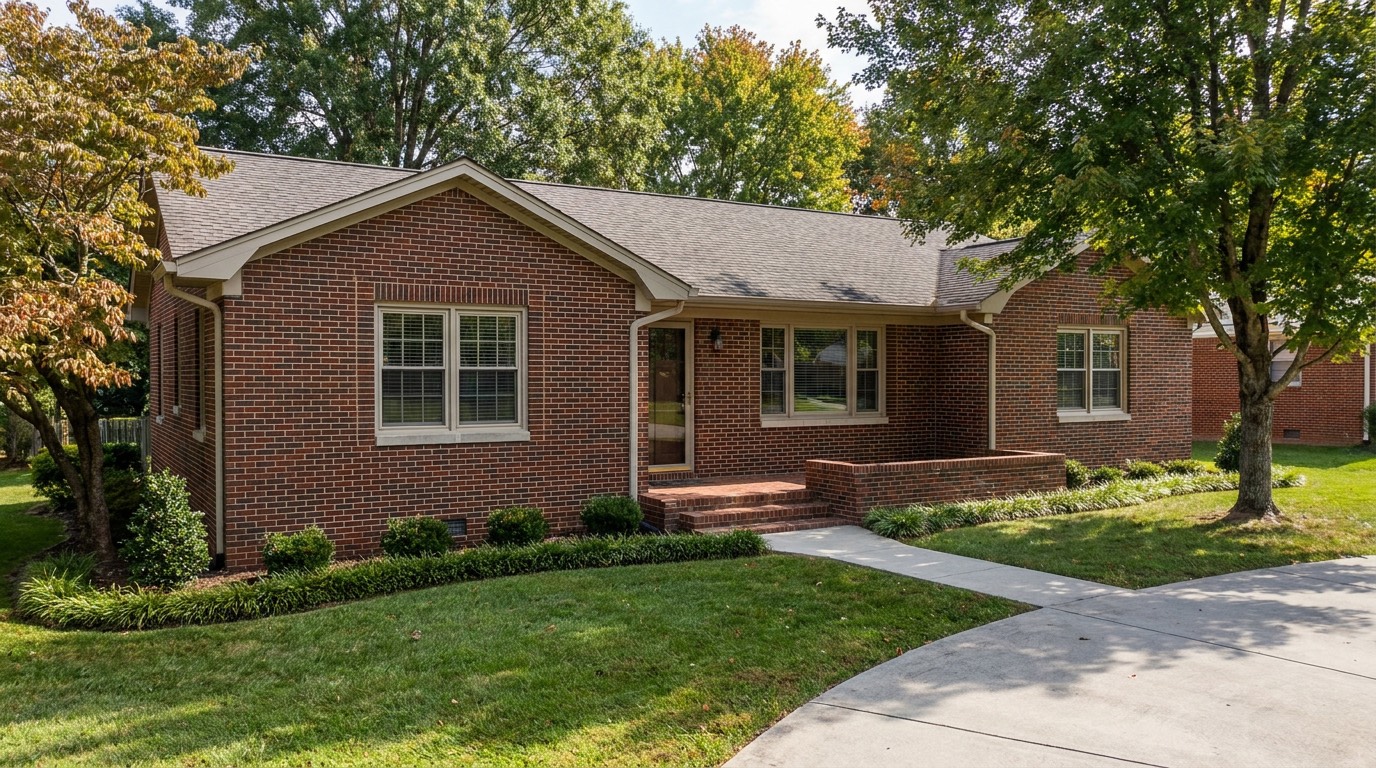 Maintenance
The Annual Masonry Walk-Around Any Homeowner Can Do
You are not diagnosing anything. You are building a record, so that next year you can tell what moved and what has been sitting still since the house was built.
Read Seasonal
The Real Masonry Season in Middle Tennessee
Unlike trades in the Sunbelt, masonry in Rutherford County has a genuine season. Here is how each part of the year behaves, and why winter is a slowdown rather than a shutdown.
ReadWhat Brick Repair Costs in Murfreesboro, and What Moves the Number
Brick repair is priced off joint count, brick match and how a crew reaches the wall, not off the damage you can see from the driveway. Here is the frame homeowners around Rutherford County run into.
ReadBrick Veneer or Solid Masonry: Two Walls That Look Identical
From the street they look the same. Behind the brick, one wall is carrying your house and the other is carrying only itself, and that changes what every crack means.
ReadBulging Brick: What It Means and When It Is Serious
Most people find it by accident, standing at the wrong angle in evening light. A bulge is not automatically an emergency, but it is never nothing, and the difference is measurable.
ReadStraight answer on your wall.
Call, or send the form and we will get you a written price.